Banks & NBFCs
Advisory on procedurally correct SARFAESI notice drafting, Section 14 DM applications, auction process compliance, and NPA portfolio strategy under RBI IRAC Prudential Norms.
Learn More →As per BCI Rules, Part VI, Chapter II, Rule 36
As per the rules of the Bar Council of India (Rule 36, Section IV), advocates and law firms are strictly prohibited from soliciting work or advertising their services in any format. This website is published for educational and informational purposes only.
By clicking "I AGREE & PROCEED", you confirm:
🍪 By proceeding you consent to functional cookies and agree to our Privacy & Cookies Policy.
Specialist consultancy combining 35+ years of core banking experience at SBI's Stressed Assets Management Branch with practising advocate expertise — helping banks, high-value NPA borrowers (₹5 Cr+), and auction purchasers understand their rights and obligations under the SARFAESI Act and DRT framework. Serving Punjab & Haryana High Court jurisdiction.

Adv. Shakti Kumar Jain · Practicing Advocate
B.Com (Hons.) · CAIIB · LL.B. · Member, Bar Council of Punjab & Haryana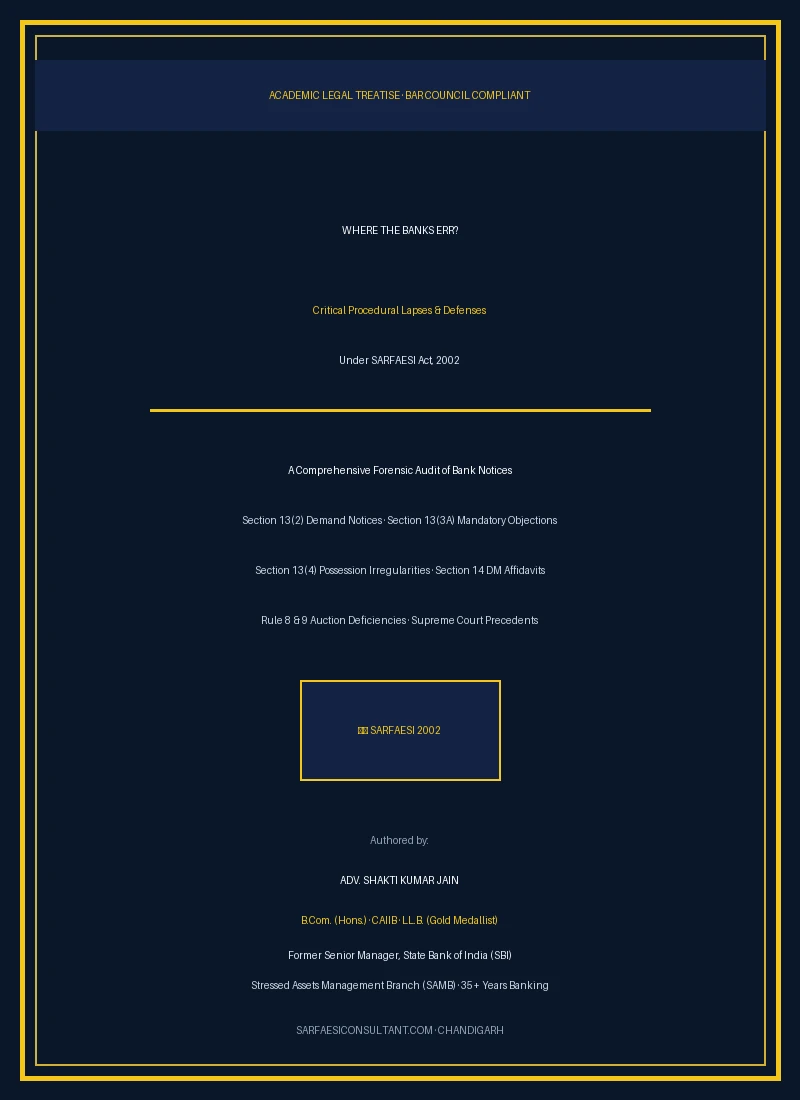

Authored by Adv. Shakti Kumar Jain (B.Com. Hons., CAIIB, LL.B. Gold Medallist, Retired Senior Manager SBI SAM Branch with 35+ years banking). A forensic treatise analyzing Section 13(2), 13(3A), 13(4), and Section 14 notice vulnerabilities across 16 illustrated spring-bound pages. Offered completely free for academic awakening.
This consultancy focuses on high-value NPA accounts where institutional knowledge of both bank operations and legal procedure provides real analytical depth.
Advisory on procedurally correct SARFAESI notice drafting, Section 14 DM applications, auction process compliance, and NPA portfolio strategy under RBI IRAC Prudential Norms.
Learn More →Informational guidance on understanding Section 13(2) notices, grounds for Section 17 DRT applications, OTS negotiation frameworks, and borrower rights established by Supreme Court judgments — for accounts with ₹5 Cr+ exposure.
Learn More →Due diligence guidance on SARFAESI auction properties — understanding title risks, pending DRT challenges, Section 14 physical possession procedures, and encumbrance verification before bidding.
Learn More →An educational overview of the statutory recovery timeline under the Securitisation and Reconstruction of Financial Assets and Enforcement of Security Interest Act, 2002. Source: India Code — SARFAESI Act 2002 (indiacode.nic.in)
Before any SARFAESI action, the bank must classify the account as a Non-Performing Asset per RBI Income Recognition and Asset Classification (IRAC) prudential norms — typically after 90 days of default. This classification is a mandatory prerequisite. Any defect in classification can be a ground of challenge before the DRT.
The Authorised Officer (not an external advocate) issues a written demand notice specifying the amount due and the secured assets. The borrower has 60 days to discharge the liability. This window is critical — borrowers should file a written representation under Section 13(3A) and the bank is legally obligated to respond with reasons if rejecting objections (Mardia Chemicals v. UOI, 2004 — Indian Kanoon).
After 60 days without repayment, the bank may take symbolic possession of the secured asset and issue a possession notice. The bank must obtain valuations from two IBBI-registered or approved valuers before proceeding to auction. Borrowers have 45 days from this stage to file a Section 17 Securitisation Application before the DRT.
If the borrower resists possession, the bank applies to the District Magistrate (DM) or Chief Metropolitan Magistrate (CMM) with a statutory 9-point affidavit. The DM's role is ministerial — to assist in possession — not adjudicatory. Borrowers contesting at this stage must approach the DRT under Section 17, not civil courts (civil court jurisdiction is barred under SARFAESI Section 34).
The bank publishes an auction notice (typically 30 days before sale). The Supreme Court in Celir LLP v. Bafna Motors (2023) 9 SCC 587 clarified that the borrower's right of redemption under Section 13(8) is extinguished once the auction notice is published where a third-party purchaser is involved. Act before publication — see Celir LLP judgment — Indian Kanoon.
The Debt Recovery Tribunal is the primary forum for borrowers challenging SARFAESI actions. The DRT can examine procedural compliance, grant interim stays (with or without pre-deposit conditions), and set aside bank actions where statutory violations are proved. DRAT is the appellate forum above DRT. High Court writs under Article 226 are generally not entertained where DRT remedy is available, unless there is a fundamental jurisdictional error.
Verified open-source judgments with plain-language explanations. All links point to Indian Kanoon (indiankanoon.org) — India's free, open-source legal database. These are for educational reference only.
When a bank moves to auction your property under the SARFAESI Act, the law provides specific forums and timelines for challenge. The primary remedy is a Securitisation Application (S.A.) under Section 17 before the Debt Recovery Tribunal within 45 days of the bank's action (Section 13(4) notice or Section 14 possession). A stay on the auction may be granted by the DRT on sufficient grounds.
Common grounds examined in Section 17 applications include: non-compliance with Section 13(2)/(3A) notice requirements, procedural irregularities in valuation (less than 2 registered valuers), defective Section 14 affidavit, incorrect NPA classification date, or failure to send notice to guarantors. These are educational pointers — every case turns on its own facts. Consult a qualified advocate immediately.
Original educational articles on SARFAESI Act, NPA resolution, and DRT proceedings. All content is informational — not legal advice. Last reviewed October 2026.

What SARFAESI means, how it works, who is covered, and what borrowers must do on receiving a Section 13(2) notice.

Step-by-step guide to DRT proceedings, how to file a Securitisation Application, and what One-Time Settlement means in 2025–26.

What auction purchasers need to verify before bidding — title risks, pending DRT challenges, encumbrances, and Section 14 possession process.
Real questions asked by NPA borrowers, banks, and auction purchasers. Answers are educational — not legal advice. Consult a qualified advocate for your specific situation.
The SARFAESI Act 2002 empowers banks and notified NBFCs to enforce security interests — including taking possession of and selling mortgaged property — without a court decree, once an account is classified NPA. The Act contains mandatory procedural safeguards: 60-day demand notice, right to file objections, right to appeal before DRT under Section 17. Courts have consistently held that procedural compliance by the bank is non-negotiable. Read SARFAESI Act — India Code ↗
File a Securitisation Application (S.A.) under Section 17 before the DRT within 45 days of the bank's action and simultaneously apply for an interim stay on the auction. The DRT may grant a stay if grounds of statutory violation are established. Note: filing alone does NOT automatically stay the auction — a separate stay application must be made. The Supreme Court in Mardia Chemicals (2004) confirmed banks must follow due process. Mardia Chemicals judgment ↗
Within the 60-day window: (1) File a written representation under Section 13(3A) — the bank must consider it and send a reasoned reply before proceeding further; (2) Gather all loan documents and verify the outstanding amount and NPA classification date for any errors; (3) Explore OTS or alternate financing; (4) Consult a qualified SARFAESI advocate. The 60-day period is your most effective window — do not waste it.
OTS is a negotiated compromise to settle NPA debt at a mutually agreed amount, typically involving waiver of penal interest and possibly part of contractual interest. The RBI issued a Compromise Settlement Framework Circular in June 2023 providing guidelines for banks. RBI Circular ↗ A well-structured OTS proposal should clearly state the offered amount, payment timeline, and request for full-and-final closure with NOC. OTS leverage is highest before auction notice publication.
Yes. The Supreme Court in Transcore v. Union of India (2008) 1 SCC 125 held that SARFAESI enforcement and DRT proceedings (Original Application) are complementary remedies — banks can run both simultaneously. A bank need not withdraw its DRT OA before initiating SARFAESI enforcement. This means borrowers may face simultaneous recovery pressure on two fronts. Transcore judgment ↗
An auction purchaser receives a Sale Certificate from the Authorised Officer and can seek physical possession under Section 14 through the DM/CMM. However, the purchase is subject to any DRT challenge filed before the sale. The purchaser should verify: pending litigation at DRT/High Court, exact encumbrances, property title chain, actual possession status, and dues to local authorities. Due diligence before bidding is critical.
This consultancy primarily handles matters before Punjab & Haryana High Court and DRT Chandigarh, serving clients across Punjab, Haryana, Himachal Pradesh, J&K, and Chandigarh UT. For matters in other jurisdictions, referrals or associated counsel arrangements may be discussed. All consultations are for high-value accounts (₹5 Cr+ exposure). Contact via email or WhatsApp during office hours (11am–5:30pm IST, Mon–Sat).
No. Under Section 31(i) of the SARFAESI Act, 2002, the provisions of the Act explicitly do NOT apply to any security interest created in agricultural land. Banks possess zero jurisdiction to attach, take possession of, or auction agricultural land under SARFAESI. Furthermore, under Section 31(h), the Act does not apply if the total outstanding debt is ₹1 Lakh or less, and under Section 31(j), if the remaining unpaid amount is less than 20% of the principal and interest. If a bank initiates Section 13(2) or Section 13(4) measures on agricultural land or sub-20% balances, the action is void ab initio and can be quashed before the DRT or High Court. SARFAESI Section 31 Exemptions — India Code ↗
A secured creditor cannot summarily dispossess a bona fide tenant whose lease was validly executed prior to the mortgage, or created with the mortgagee bank's express consent under Section 65A of the Transfer of Property Act, 1882. As settled by the Supreme Court in Harshad Govardhan Sondagar v. International Assets Reconstruction Co. Ltd. (2014) 6 SCC 1 and reaffirmed in Bajarang Shyamsunder Agarwal v. Central Bank of India (2019) 9 SCC 561, the District Magistrate (DM) or Chief Metropolitan Magistrate (CMM) under Section 14 cannot evict a lawful tenant holding a valid registered lease until the lease expires or is determined in accordance with state rent control laws. The bank can only take symbolic possession and receive rent from the tenant. Harshad Sondagar judgment ↗
Yes. Under Section 128 of the Indian Contract Act, 1872, the liability of a guarantor is co-extensive with that of the principal debtor. The Supreme Court in State Bank of India v. V. Ramakrishnan (2018) 17 SCC 394 and Industrial Investment Bank of India Ltd. v. Biswanath Jhunjhunwala affirmed that a secured creditor has the full legal prerogative to proceed against mortgaged properties of personal guarantors simultaneously or even prior to exhausting remedies against the principal borrower. Guarantors must be individually served demand notices under Section 13(2) and retain equal rights to submit objections under Section 13(3A) and challenge actions before the DRT under Section 17. SBI v. Ramakrishnan judgment ↗
Section 13(3A) mandates that when a borrower submits written representations or objections within the 60-day notice period, the bank MUST consider them and communicate a reasoned speaking order within 15 days if the objection is rejected. The Supreme Court in Mardia Chemicals Ltd. v. Union of India established that considering objections is a vital procedural safeguard against arbitrary bank action. If the bank fails to respond within 15 days, or issues a mechanical, unreasoned rejection, any subsequent coercive step (such as a Section 13(4) possession notice or Section 14 DM order) is procedurally tainted, illegal, and liable to be set aside by the DRT under Section 17.
Following the 2016 statutory amendment to Section 13(8) of the SARFAESI Act and the landmark Supreme Court ruling in Celir LLP v. Bafna Motors (Mumbai) Pvt. Ltd. (2023) 9 SCC 587, a borrower's right of redemption is strictly restricted. The borrower can redeem the property only by tendering the full outstanding dues plus costs before the date of publication of the auction notice. Once the public auction notice is published or bidding concludes, the borrower's statutory right to redeem extinguishes in favor of protecting bona fide auction purchasers. Late payments on the eve of auction cannot derail a concluded public sale. Celir LLP v. Bafna Motors judgment ↗
No. Section 34 of the SARFAESI Act imposes a total jurisdictional bar on civil courts. No civil court has the power to entertain any suit or proceeding in respect of any matter which the DRT or DRAT is empowered to determine, nor can any civil court grant an injunction against actions taken under the SARFAESI Act. The Supreme Court in United Bank of India v. Satyawati Tondon (2010) 8 SCC 110 emphasized that the SARFAESI Act is an exhaustive special code; aggrieved borrowers must exhaust their statutory remedies before the DRT under Section 17 rather than approaching civil courts or filing premature High Court writ petitions. Satyawati Tondon judgment ↗
Under Rule 9(3), 9(4), and 9(5) of the Security Interest (Enforcement) Rules, 2002, the successful auction bidder must deposit 25% of the purchase price (inclusive of EMD) on the day of auction or the next working day. The balance 75% must be remitted within 15 days of sale confirmation (or within an agreed extended window not exceeding 3 months in writing). If the bidder defaults, the bank is statutorily mandated to forfeit the entire 25% deposit, cancel the sale confirmation, and re-auction the property. The defaulting bidder loses all legal claim to the deposit money and the property.
Generally no. Section 32 of the SARFAESI Act provides statutory immunity: no suit, prosecution, or legal proceedings shall lie against any secured creditor, Authorised Officer, or person acting on their behalf for anything done or intended to be done in good faith under the Act or rules. Police stations and criminal courts routinely dismiss FIRs and private complaints filed by defaulting borrowers against bank officers carrying out lawful SARFAESI procedures, unless there is distinct, demonstrable evidence of independent criminal offenses like fraud, forgery, or violence that fall outside official statutory authority.
Symbolic (constructive) possession is assumed under Section 13(4) read with Rule 8(1) & (2) when the Authorised Officer serves a possession notice upon the borrower, affixes it on the property gate/door, and publishes it in two newspapers within 7 days. The borrower remains in physical occupancy. If the borrower refuses to vacate peacefully, the bank cannot take the law into its own hands; it must file an application under Section 14 before the District Magistrate (DM) or Chief Metropolitan Magistrate (CMM) to secure actual physical possession with police assistance.
Under Section 13(7) of the SARFAESI Act, auction proceeds must be applied in strict priority: first, towards statutory costs, charges, and expenses properly incurred by the bank; second, towards discharging the borrower's principal debt, accrued interest, and legal costs. If any surplus remains, the secured creditor holds the funds in a fiduciary capacity and is legally bound to disburse them to subsequent mortgagees or immediately refund the entire surplus balance to the mortgagor/borrower.
Yes. In an OTS compromise, because the lender waives a portion of contractual interest or principal, banks report the account status to credit bureaus (CIBIL, Experian, CRIF) as 'Settled' or 'Written Off' rather than 'Closed'. This severely depresses credit scores and acts as a red flag for institutional credit for up to 7 years. To restore creditworthiness, borrowers can later negotiate to remit the waived haircut amount, thereby converting the status to 'Closed' and receiving a pristine 'No Dues Certificate' (NDC).
Yes. Section 36 of the SARFAESI Act expressly restricts the secured creditor: no enforcement measure under Section 13(4) can be initiated unless the claim is within the period of limitation prescribed under the Limitation Act, 1963. For enforcing mortgaged immovable property, Article 62 provides a 12-year limitation period from the date when the money sued for becomes due. If a debt has become time-barred without any valid acknowledgement under Section 18 of the Limitation Act, SARFAESI proceedings are legally impermissible and void ab initio.
Under Rule 8(1) & (2) of the Security Interest (Enforcement) Rules, 2002, the Authorised Officer must draw up a contemporaneous Panchnama and an exhaustive inventory of all seized movable and immovable assets in the presence of two independent local witnesses (Panchas). The possession notice must be served upon the borrower, affixed conspicuously on the outer door of the secured asset, and published in two leading newspapers (one in the local vernacular language) within 7 days. Failure to draw an independent Panchnama, omission of witness signatures, or refusing to deliver a duplicate inventory copy to the borrower renders the possession procedurally illegal and liable to be quashed under Section 17 before the DRT.
Yes. Under Section 14(1-A) of the SARFAESI Act, an application for administrative possession assistance must be accompanied by an affidavit duly affirmed by the Authorised Officer covering a mandatory 9-point factual declaration. If an officer deposes falsely—such as falsely swearing that Section 13(3A) objections were answered when they were ignored, suppressing interim borrower payments, or misstating property boundaries—the officer commits perjury under IPC Sections 191, 192, and 193 (Section 227 BNS). The Magistrate or High Court can direct the registration of a criminal complaint under Section 340 CrPC / Section 379 BNSS. Read Criminal Liability of Bank Officers Guide ↗
Under Section 19 of the SARFAESI Act, if the Debt Recovery Tribunal (DRT) finds that possession was taken unlawfully or in violation of statutory rules, the Tribunal possesses express authority to order immediate restitution of property and direct the secured creditor to pay substantial compensation and legal costs to the borrower. Furthermore, where bank officials act mala fide outside the protection of Section 32 good-faith immunity (such as using physical bouncers without Magistrate orders or damaging un-mortgaged goods), they attract civil tort liability for damages and criminal complaints for trespass and wrongful restraint.
For high-value NPA accounts (₹5 Cr+ exposure). Available Mon–Sat, 11am–5:30pm IST. This form is for informational enquiries only — not for legal advice or retainer.